WoodCrafts & Slavic Gods and Art & SharPei Breed Manual

Welcome to my blog! Here you shall find informations about Ancient Gods of Slavs and Slavic heritage . My pendants and tea mugs collection with authentic design . Shar Pei breed info and manual , WoodCraft ideas. patterns and plans . Stay tuned!
Showing posts with label Goddess. Show all posts
Showing posts with label Goddess. Show all posts
Tuesday, September 29, 2015
MATI SYRA ZEMYA (MOTHER EARTH)


Since Mati Vlazna Zemlja was one of the most worshipped deities, it comes as no surprise to find traces of her cult among the Slavs even after they converted to Christianity. In Russia, after year 988 there was a period of the so-called religious duality, during which pagan gods were worshipped along with Christ and Christian saints. Characteristics of mother godde


MAKOS - The Goddess of women,mothers and magic rituals

Slavic women would throw hemp, called "mokrica" (mokar = wet), into the water. The hemp was a sacrifice offered to Mokos. Hemp yarn was not to be left over the night, lest Mokos would spin it. Another of Mokos's roles was to protect the sheep and their fleece; the Slavs made offerings to her for that reason, too. A pair of scissors, basil and a skein of wool used to be put before the feet of Mokos's statue, with the aim of insuring protection for the lambs that hadn't been shorn yet. Even after conversion to Christianity, some beliefs related to Mokos were kept. In northern Russia, there was a belief that during the Lent Mokos went from house to house supervising the spinners. It is thought that Mokos had a role similar to that of the Sudjajas (Sudjaje = the Fates). Since she was connected with spindle and distaff, it is assumed that Mokos's area of influence stretched to the cosmic plain, making her the goddess that controlled human destiny and cut the short thread of human life.

Another action related to Mokos was casting spells. The women that practiced sorcery in the 16th century Russia were called mokose. Aleksandra Bajic brings Mokosa in connection with Baba-Jaga, a witch from Russian fairy tales that lives in a cottage placed on chicken legs as foundations and helps boys and girls by giving them magic objects. A question arises, however, whether Mokos was originally a witch goddess or she became one after Christianisation.
Mokos was a goddess of the Kiev pantheon. Her statue was erected by prince Vladimir in 980 AD on a hill above Kiev, but it was pulled down by the same prince eight years later, after he converted to Christianity. How was Mokos represented? In northern Russia she was imagined as a woman having a big head and long arms. Vollmer, the historian, mentions Mokos's statue representing a figure put together from parts of different animals. Owing to that, Mokos was considered to be the goddess of ugliness, pains, troubles and human passion, but this interpretation has no foundation in the traditional ways of representing Mokos.
What can we learn from etymological analysis of Mokos's name? The name of this goddess is most frequently connected with the word mek (= soft), so she could be related to something that is soft. Since she was the spinners' goddess and the protector of the sheep, it is most probable that the adjective "soft" refers to fleece. Mokos could also be connected with the adjective mokro (= wet), which makes some authors identify her with Majka Vlazna Zemlja. This identification is certainly based on one of Mokos's characteristics – she was also seen as the goddess of fertility. The rain was therefore sometimes referred to as "Mokos’s milk". The term Mokos is also used in Finland, where it can usually be found as a surname. The Finns are thought to have taken this name over from the Slavs, or to be more precise, those whose last name is Mokos are thought to be of Slavic origin.

Mokos's characteristics were transferred onto St. Petka. St. Petka is also the protector of women, and it is interesting to know that Vlach women frequently mention this saint while performing magic rituals. Some of them pray to St. Petka to help them perform the ritual, and she even appeared to a man to welcome him into a witch cult. Mokos's holy day is Friday – women must not spin on that day, otherwise Mokos will punish them. The festival dedicated to this goddess was celebrated some time between 25th October and 1st November, depending on which date happened to be Friday. As we know, St Petka's Day is celebrated on 27th October, and that holiday is fixed to that date, although it probably shouldn't be because Friday is dedicated to female deities Freya (Friday) and Venus (venerdì). On Mokos's holiday people would go to a lime-tree wood and make offerings usually consisting of herbs and various vegetables, but there is also a record that they sometimes sacrificed birds to this goddess.
ZIVA Goddess of living water, life, love and fertility
 Živa, (also Živa, Šiva, Siwa, Żiwia),
was the Slavic goddess of life, love and fertility. She was worshipped
throughout what is now Poland, the Czech Republic, Slovakia, Slovenia
and Germany (and especially the Elbe (Labe) river valley), before
Christianity expanded into the area.
Živa, (also Živa, Šiva, Siwa, Żiwia),
was the Slavic goddess of life, love and fertility. She was worshipped
throughout what is now Poland, the Czech Republic, Slovakia, Slovenia
and Germany (and especially the Elbe (Labe) river valley), before
Christianity expanded into the area.
She was wife of one of the main Slavic
gods – Dažbog – the god of sun. Together they showed up like twins
creating the symbol of pigeon.
She was an impressive woman with long hair and powerful eyes.
Goddess Živa originated in the remote antiquity. The name of the goddess can be traced as far back as North Africa. Yet, the furthest we go back into prehistory, the clearer she emerges, not so much as goddess, but as life itself. The meaning of Živa in Slavic languages is life or living.
 Goddess of living water has also been retained in the folk memory
in many customs where water plays a crucial role. Maidens in the
environs of Ljutomer make offerings to water on New Year’s Eve. In
another custom a red apple must be thrown into the spring before
sunrise. In her portrayal in Helmold’s chronicle, which had been
published in 1639 by Heinrich Bangert, Živa holds an apple in her hands.
From this it is possible to deduce, that in the folklore of Polabians
as well, the apple was preserved as love symbol of the goddess.
Goddess of living water has also been retained in the folk memory
in many customs where water plays a crucial role. Maidens in the
environs of Ljutomer make offerings to water on New Year’s Eve. In
another custom a red apple must be thrown into the spring before
sunrise. In her portrayal in Helmold’s chronicle, which had been
published in 1639 by Heinrich Bangert, Živa holds an apple in her hands.
From this it is possible to deduce, that in the folklore of Polabians
as well, the apple was preserved as love symbol of the goddess.
Goddess Živa originated in the remote antiquity. The name of the goddess can be traced as far back as North Africa. Yet, the furthest we go back into prehistory, the clearer she emerges, not so much as goddess, but as life itself. The meaning of Živa in Slavic languages is life or living.
Among the deities of Slavic Polabians, above all Abodriti or
Bodrici (Mecklenburg), the goddess Živa, or Živena among Slovakians, had
a special place. Historical sources refer to her most often under the
name Siwa, and recorded variously as Sivve, Shiwa, Sieba, Syeba, and
Dsiva. She was goddess of fertility and love, the greatest female deity
in the pantheon of Polabians. Tomaž Linhart, Slovenian 18th century
historian, writes: Shiva, goddess of life; she was worshipped by
Polabians. Raniolans have given this title to the planet Venus.
Živa was above all the goddess of water. In the consciousness of
people she represented the concept of life, personified by water. She
was their first “goddess”, even before mother Earth, who rules when the
spread of agriculture follows.
The chief holy place of goddess Živa was in the city Ratibor
(Ratzenburg), south of Lubice (later Lübeck). The city is situated on
the island of a sizable lake. On the island a powerful stream gushes to
the surface, named Aqua Siwa. Today there is a spa on this spot. We come
upon goddess Živa in the mythology of other nations in Middle Europe,
that stem from the ancient Veneti. In the tradition of Slovaks for
example she appears under the name Živena. 

Chronicler Helmold calls Živa Polabian “goddess”, but in common
with other chroniclers does not describe her. Her image appears only in
the second publication of his chronicle in the year 1659. There are
many indications that the goddess Živa was symbolically represented in
the stream of fresh water, the source of all life. Her figure, which it
would be evidently impossible to portray in its true symbolism reflects
more than a female figure, - youth, beauty and tenderness, life and its
renewal.... All that the later goddesses of love, for example Greek
Aphrodite or Roman Venus express only to some extent.
Goddess Živa had vanished from memory, but the folk tradition has
retained her figure and meaning in various guises. There are records
particularly referring to “living water”, sometimes as focus of worship
that indicates either by name or indirectly the goddess of life, Živa.
It is probable that the worship of Fata in Oglej (Aquileia),- a
maiden goddess who foretells future, and is connected with births, can
be identified with Živa. Like a number of Celtic deities, it would
appear, as indicated on several preserved inscriptions, that she was
transposed into the Roman pantheon of gods, and became Fata, dea
barbarica.
There are no direct records about how much was Živa, her Polabian
version, connected with the figure of female beauty and fertility. That
she was an important goddess we may conclude from the fact that in the
year 1157 they built a cathedral on the hill in Ratibor, where her
temple had stood.
About her worship in Carantania there are also no records. However,
Slovenian historian Linhart writes: Shiva, goddess of life; she was
worshipped by Polabians, Raniolans have given this title to the planet
Venus. Linhart’s record is of the essence in further pursuit of her
presence in pre-christian pantheon of Carantanians.
There is a strong tradition that the temple, which preceded the
Christian church on the Isle of Bled was dedicated to Živa. Diggings
which archaeologists undertook on the island after World War II,
discovered under the church remains of older foundations. Among them
also the foundation, that provided the support for a square wooden house
at the time of christianization in the 8th century. Attached to it was
square building with apse from 9th century, an indication of the
influence of Oglej. In both buildings, whose foundations were uncovered,
transition from pagan “hram” to early christian church can be clearly
seen. Was the pagan temple dedicated to goddess Živa? Christian
missionaries consistently translated worship of pagan goddesses into the
worship of Mother of God. Church on the Lake Bled is consecrated to the
Ascension of Mary.
The temple of Živa on the Isle of Bled and the waterfall on the
Savica River were commemorated and celebrated in the epic poem Baptism
on Savica by the 19 century Slovenian poet France Prešeren.
 Goddess of living water has also been retained in the folk memory
in many customs where water plays a crucial role. Maidens in the
environs of Ljutomer make offerings to water on New Year’s Eve. In
another custom a red apple must be thrown into the spring before
sunrise. In her portrayal in Helmold’s chronicle, which had been
published in 1639 by Heinrich Bangert, Živa holds an apple in her hands.
From this it is possible to deduce, that in the folklore of Polabians
as well, the apple was preserved as love symbol of the goddess.
Goddess of living water has also been retained in the folk memory
in many customs where water plays a crucial role. Maidens in the
environs of Ljutomer make offerings to water on New Year’s Eve. In
another custom a red apple must be thrown into the spring before
sunrise. In her portrayal in Helmold’s chronicle, which had been
published in 1639 by Heinrich Bangert, Živa holds an apple in her hands.
From this it is possible to deduce, that in the folklore of Polabians
as well, the apple was preserved as love symbol of the goddess.
The figure of Živa, the ancient goddess of water, fruitfulness and
love did not completely vanish from Slovenian folklore. Christianity
drove the name of the pagan goddess into oblivion. However her image has
been preserved in tales and myths about white woman (orig. Sl. bela
žena) the washer-woman (orig. Sl. perica) or god’s maiden (orig. Sl.
božja deklica), and in seasonal customs centred on springs and wells in
Slovenian folk tradition.
DANU (DANA) - The Goddess of Rivers, Water, Wells, Magic

Danu (Dana) is a Goddess of Rivers, Water, Wells, Prosperity, Magick,
and Wisdom. She is the well known and honored in NorthEast Europe too. She is
the equivalent to the Welsh Don, the mother Goddess. She is sometimes
both a god and goddess, and thought of as an all-encompassing Divine
Source. She is associated with fertility, abundance, cultivation and
the nurturing of the land.
Goddess
Danu is considered the most ancient of all Celtic Deities. Her name
means knowledge, wisdom, teacher, wealth and abundance. She is also
known as Dana and as her Welsh equivalent, Don.
 Some
references have her as so ancient that she is both goddess and god and
refer to Danu as an all-encompassing Divine Source.
Some
references have her as so ancient that she is both goddess and god and
refer to Danu as an all-encompassing Divine Source. This multi-faceted aspect of the Divine Feminine is experienced as the air we breathe, as the river that nourishes all of life, as the bounty and abundance of earth and as the cosmic energy of universal wisdom.
A Triple Goddess, which means she is able to take the form of the Maiden, the Mother or the Crone, and a Divine Lady who is the essence of the earth, the air and the essence of water, Danu is able to embody the form/energy suited the situation. Here she brings the power of versatility and teaches us to honor and respect diversity within ourselves and within others and reminds us to honor each stage of our physical life.
Goddess Danu is strongly associated with the Tuatha de Dannan, which means “The Children of Danu.” The Tuatha de Dannan are believed to have been the wise ones, the alchemists of ancient Ireland. Some references have them as actual descendants of Danu. It is believed that when the Gaelics invaded Ireland, the Tuatha de Dannan shape shifted to the Sidhe (shee) who are considered the “farey folk” or the Leprechauns of Ireland. Danu will act as a Divine Ambassador to the Elemental Kingdoms, providing platforms for positive interactions with the Leprechauns and the Faery Folk.
 Some
of Danu’s symbols include holy stones, horses – particularly mares,
seagulls, fish, amber, gold, royalty/empress, rivers, sea, flowing
water, air, wind, earth, moon, keys and crowns.
Some
of Danu’s symbols include holy stones, horses – particularly mares,
seagulls, fish, amber, gold, royalty/empress, rivers, sea, flowing
water, air, wind, earth, moon, keys and crowns.Danu is commonly considered the first Great Mother of Ireland, Divine Creator aspect of the Goddess who birthed all things into being. She is an Earth Goddess, associated with fertility, growth, plenty, abundance, agriculture, cultivation and with nurturing of the land.
Rivers, flowing water and the sea are also Danu’s Domain. Within this water form she wields the magic of Divine Flow. This River Goddess offers to clear stagnant energy and to remove blockages so that our efforts easily flow into fruition. As the river eventually flows into the sea, here Danu brings motivation to move within the direction of our dreams.
Danu brings the attributes of inspiration, intellect, change and transcendence within her aspect as a Goddess of Air. As a Cosmic Goddess, Danu is the essence of Universal Wisdom and Divine Knowledge. She knows the secrets of Divine Alchemy and Divine Magic and reminds us that through our Oneness to the Divine Source, there really are no “secrets,” we are essentially one with All Encompassing Universal Wisdom.
Within all her forms Danu brings the reminder that the power to create the life that we desire resides within us. She reminds us that we are innately attuned with the wisdom of our Ascended Self, and through the integrity of our Divine Essential Self our power is always aligned with Purity of Purpose.
 As
a Sovereign Goddess, she assists us in transcending the illusions of
unworthiness, providing the reminder that our essence is an aspect of
the Divine Source. Danu reminds us of our Royal Roots, reminding us of
our Divine Heritage. Reminding us that we are Divine and thus so we are
aligned with infinite potential and with infinite possibility.
As
a Sovereign Goddess, she assists us in transcending the illusions of
unworthiness, providing the reminder that our essence is an aspect of
the Divine Source. Danu reminds us of our Royal Roots, reminding us of
our Divine Heritage. Reminding us that we are Divine and thus so we are
aligned with infinite potential and with infinite possibility. Within this energy, Danu is the Goddess of Dreams Come True. Reminding us that we are absolutely worthy and completely capable of realizing our Greatest Dreams. Reminding us that we innately know our Highest Truth. Enabling us to transcend lesser goals born of low self worth and goals born of the lower self’s limited vision, empowering us to embrace our Golden Dreams, Dreams worthy of our Divine Consciousness.
Goddess Danu specializes in realigning us with our Divine Truth, our Truth that is abundant, flourishing, fertile, wise and empowered. Danu brings empowerment with the remembrance that we each are the director of our own destiny and that within us we wield the power to realize our Greatest Dreams Come True.
Danu is an ancient and eternal essence of the Goddess, an affirmation of the enduring energy of the Divine Feminine. She brings the steadfast love and support of a Mother Goddess and is a wonderful representation of the infinite, all encompassing Divine Universal Source. A powerful guide for those who seek to Remember their Highest Truth, Danu is dedicated to our realizing our greatest dreams, she is motivating, encouraging and always promotes the awareness that the power to achieve anything, resides within us.
Danu (Da-noo) is the mother of the Celtic Gods, the
goddess of rivers, and her name means knowledge, wisdom, wealth and abundance.
She is also known as Dana, Anu or Don and she encompasses both light and dark,
meaning she both gives and takes. She is extraordinary and is known as a triple
Goddess, meaning that she can take the forms of maiden, mother or crone. She
can embody all sorts of energy and forms so she can adapt to the current
situation at hand.
The colours that represent her are green, silver, blue and
black. Danu has the extraordinary capability to connect to more than one
element, but she is mainly linked to water and air. Because of this, many
animals are linked to her – including the snake, fish, mare, and seagull. Some
other symbolism includes holy stones, amber and of course, flowing water. She
is highly associated with fertility, growth, cultivation, and abundance, mainly
since she nourishes the earth.
With her being considered the most ancient of the Celtic
Deities it’s remarkable as to how few stories there are about her. They are
hard to come across, even though the Danube river and a mountain on the face of
Venus are named after her. However, it appears the most popular tale is in regards
to the ‘Children of Danu’, her followers. It is believed that when Ireland was
invaded, the children panicked and were able to shape-shift. Choosing to shift
into Fae and Leprechauns. Some versions say that her followers were actually
born from her, but that is up for debate. Because of her help with the
children, she became known to provide positive interactions with the
leprechauns and fae.
Danu has the amazing ability to provide one with luck and
good wishes. She brings power and teaches us to respect one another and ourselves.
Just as the mighty, powerful river flows into the vast, open sea, Danu brings
us to our dreams. She helps us reach them and pushes us to motivation- showing
us what we are capable of. If you are feeling down, lacklustre,
uninspired, and just not having any luck, Danu is the one to go to.
Danu
(Da-noo) is the mother of the Celtic Gods, the goddess of rivers, and
her name means knowledge, wisdom, wealth and abundance. She is also
known as Dana, Anu or Don and she encompasses both light and dark,
meaning she both gives and takes. She is extraordinary and is known as a
triple Goddess, meaning that she can take the forms of maiden, mother
or crone. She can embody all sorts of energy and forms so she can adapt
to the current situation at hand.
The colours that represent her are green, silver, blue and black. Danu has the extraordinary capability to connect to more than one element, but she is mainly linked to water and air. Because of this, many animals are linked to her – including the snake, fish, mare, and seagull. Some other symbolism includes holy stones, amber and of course, flowing water. She is highly associated with fertility, growth, cultivation, and abundance, mainly since she nourishes the earth.
With her being considered the most ancient of the Celtic Deities it’s remarkable as to how few stories there are about her. They are hard to come across, even though the Danube river and a mountain on the face of Venus are named after her. However, it appears the most popular tale is in regards to the ‘Children of Danu’, her followers. It is believed that when Ireland was invaded, the children panicked and were able to shape-shift. Choosing to shift into Fae and Leprechauns. Some versions say that her followers were actually born from her, but that is up for debate. Because of her help with the children, she became known to provide positive interactions with the leprechauns and fae.
Danu has the amazing ability to provide one with luck and good wishes. She brings power and teaches us to respect one another and ourselves. Just as the mighty, powerful river flows into the vast, open sea, Danu brings us to our dreams. She helps us reach them and pushes us to motivation- showing us what we are capable of. If you are feeling down, lacklustre, uninspired, and just not having any luck, Danu is the one to go to.
- See more at: http://paganpages.org/content/tag/danu/#sthash.GOtjUqTL.dpuf
The colours that represent her are green, silver, blue and black. Danu has the extraordinary capability to connect to more than one element, but she is mainly linked to water and air. Because of this, many animals are linked to her – including the snake, fish, mare, and seagull. Some other symbolism includes holy stones, amber and of course, flowing water. She is highly associated with fertility, growth, cultivation, and abundance, mainly since she nourishes the earth.
With her being considered the most ancient of the Celtic Deities it’s remarkable as to how few stories there are about her. They are hard to come across, even though the Danube river and a mountain on the face of Venus are named after her. However, it appears the most popular tale is in regards to the ‘Children of Danu’, her followers. It is believed that when Ireland was invaded, the children panicked and were able to shape-shift. Choosing to shift into Fae and Leprechauns. Some versions say that her followers were actually born from her, but that is up for debate. Because of her help with the children, she became known to provide positive interactions with the leprechauns and fae.
Danu has the amazing ability to provide one with luck and good wishes. She brings power and teaches us to respect one another and ourselves. Just as the mighty, powerful river flows into the vast, open sea, Danu brings us to our dreams. She helps us reach them and pushes us to motivation- showing us what we are capable of. If you are feeling down, lacklustre, uninspired, and just not having any luck, Danu is the one to go to.
- See more at: http://paganpages.org/content/tag/danu/#sthash.GOtjUqTL.dpuf
VESNA - The Goddess of Spring and Youth
 Vesna was the goddess of spring, and was associated
with youth.
Vesna was the goddess of spring, and was associated
with youth.
Vesna was a very popular goddess among people because she
replaced winter and death that is Morena. Morena, however, was the goddess of
winter, and this time for the Slavs (mainly northern) was associated with
death. In past times winter was characterized by a scarcity of food from
various diseases caused by the cold, and then associated with death. Vesna wore
the green fields, the meadows, nice weather, favorable to life and work.
With these changes in the nature Vesna brought joy into the homes of the Slavs.
The Slavs celebrated spring because it won winter and announced the summer
season. As spring symbolized the beginning of a beautiful season, when it
bloomed, the nature awoke, all was reborn and renewed life, Vesna had her role
as a goddess of youth.
Vesna was one of the sunnier goddesses and
was loved by people very much. Vesna represented spring
in Slovene mythology and is
still the poetic word for spring in the Slovene and Slovak languages.

It is precisely for this reason in particular the Serbs,
had the custom of giving the name Vesna to a female. People, who gave the
name Vesna to a daughter, believed that their daughter would be happy and
cheerful just like the goddess Vesna, or, as spring. Her name comes from an
Indian word vas that means solar, illuminated and shiny. The word vas is
located in the root of the name Vesna. This also shows that the deity Vesna was
present in the Slavic people even when they were in India, and before they
moved to Europe. In particular, Vesna was a model for women. She was beautiful
and powerful and around her the wonderful scent spread. In addition to beauty,
she is also attributed to the power of the Sun, without which she could not get
spring.
Vesna was never alone. She was always
accompanied by Gerovit, who watched her constantly, and Stribog, the god of
wind and air.
 Vesna was also the goddess of victory. She could overcome death and winter, and
governed nature. This victory was celebrated by the people according to their
customs. According to legend, every spring Stibog carried Vesna on the wings of
light and nice breeze. In the duel between Morena and Vesna, the Slavs had
always opted for Vesna. The Slavs had the custom to bring the doll Vesna on
branches and to burn the doll Morena. This practice symbolically marked the
victory of Vesna over Morena. Of course, the victory of Vesna was not
definitive, as all cycles were repeated every year. The fight between Morena
showed that Vesna had features that were common among mortals, intolerance
towards other women, jealousy and the struggle for power.
Vesna is Morana’s opposite. Humans consider it completely
good and fond of all people. Even though both goddesses as such are beautiful,
Morana is pale and in a way represents beauty in decay while Vesna’s rose
cheeks and luscious looks represent spring. People fear Morana and adore Vesna.
They don’t even exist in the same place at the same time.
Only when Morana and her winter leave, Stribog brings Vesna on “wind’s wings”.
In this context, Stribog was called “that who take one to bring another”. Vesna
represents the coming of life after winter hibernation and the return of light
after a period of darkness.
Polish Slavs called Vesna Devana with the added “title”
of the goddess of fertility and sometimes even the goddess of the hunt. Apart
from Vesna and Devana, the same goddess was also known as: Zhivana, Zhiva,
Siva, Diva, Deva, Devica, Danica etc. The name Lada is a lot more mysterious
than the ones mentioned just now. After Slavs converted to Christianity,
Vesna’s domain was split between St. Petka and Virgin Mary.
Vesna was also the goddess of victory. She could overcome death and winter, and
governed nature. This victory was celebrated by the people according to their
customs. According to legend, every spring Stibog carried Vesna on the wings of
light and nice breeze. In the duel between Morena and Vesna, the Slavs had
always opted for Vesna. The Slavs had the custom to bring the doll Vesna on
branches and to burn the doll Morena. This practice symbolically marked the
victory of Vesna over Morena. Of course, the victory of Vesna was not
definitive, as all cycles were repeated every year. The fight between Morena
showed that Vesna had features that were common among mortals, intolerance
towards other women, jealousy and the struggle for power.
Vesna is Morana’s opposite. Humans consider it completely
good and fond of all people. Even though both goddesses as such are beautiful,
Morana is pale and in a way represents beauty in decay while Vesna’s rose
cheeks and luscious looks represent spring. People fear Morana and adore Vesna.
They don’t even exist in the same place at the same time.
Only when Morana and her winter leave, Stribog brings Vesna on “wind’s wings”.
In this context, Stribog was called “that who take one to bring another”. Vesna
represents the coming of life after winter hibernation and the return of light
after a period of darkness.
Polish Slavs called Vesna Devana with the added “title”
of the goddess of fertility and sometimes even the goddess of the hunt. Apart
from Vesna and Devana, the same goddess was also known as: Zhivana, Zhiva,
Siva, Diva, Deva, Devica, Danica etc. The name Lada is a lot more mysterious
than the ones mentioned just now. After Slavs converted to Christianity,
Vesna’s domain was split between St. Petka and Virgin Mary.

With these changes in the nature Vesna brought joy into the homes of the Slavs. The Slavs celebrated spring because it won winter and announced the summer season. As spring symbolized the beginning of a beautiful season, when it bloomed, the nature awoke, all was reborn and renewed life, Vesna had her role as a goddess of youth.


MORANA -The Goddess of Winter and Death


Morana is the Slavic Goddess of winter and death.
As the goddess of winter she had never been loved by
Slavic peoples, because she brought death, hunger, cold and unbearable
diseases. Therefore, her coming was always awaited with fear, while her going
was celebrated with joy. Slavs honoured her always though.
A legend tells that Dazbog, a sun god, went to the underworld Nav to seek his
wife Zlatna Maja (Maja gold). In Nav he met Morana who seduced him.
After a bit of time Morena got bored of Dazbog and found another lover -
Crnobog Jula. To get rid of Dazbog Morana tried to poison him. Saved by Ziva or
Siva, Dazbog burned Morana and sent her to the underworld. This explains the
process of the evolution of the sun. According to the belief of the pagan
people, during the winter the sun is in the underworld. But his lover Morana
that during the winter did not let him go out of the underworld gave him a
drink of forgetfulness. Despite all Morana was unable to extend her kingdom
forever, because at the end of the story Dazbog got rid of her and destroyed
it.
Morana is described as a woman with dark hair and scary look, associated with
witches and other demonic creatures. However, we cannot say that Morana was
only a negative divinity. At the bottom of the heart the Slavic people
worshiped the goddess Morana despite she was not good, scared and terrified
them.
Morana is the goddess of night, winter and death. She is
most frequently portrayed as a beautiful woman with long black hair, pale white
face and wolf like fang and claws. All Slavs know Morana. She is also known as
Morena, Marena, Marana, Marzhana and Marzhena.
Vesna is Morana’s opposite. Humans consider it completely
good and fond of all people. Even though both goddesses as such are beautiful,
Morana is pale and in a way represents beauty in decay while Vesna’s rose
cheeks and luscious looks represent spring. People fear Morana and adore Vesna.
They don’t even exist in the same place at the same time.
Only when Morana and her winter leave, Stribog brings Vesna on “wind’s wings”.
In this context, Stribog was called “that who take one to bring another”. Vesna
represents the coming of life after winter hibernation and the return of light
after a period of darkness.
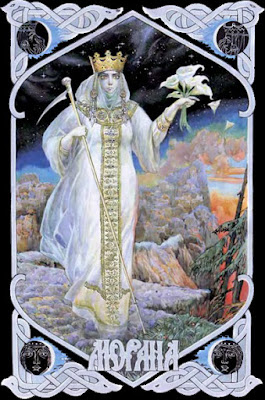
Snow, gale, hail and all of winter things come from
Morana, the goddess of death of human, animal and plant life. Her three main
attributes are winter death and darkness.
A widespread ritual of burning Morana existed. At the end
of winter many of the Slav tribes made a rag and straw doll that symbolized
Morana and burned her to help Vesna, the spring, to come faster.
A legend tells that Dazbog, a sun god, went to the underworld Nav to seek his wife Zlatna Maja (Maja gold). In Nav he met Morana who seduced him.
After a bit of time Morena got bored of Dazbog and found another lover - Crnobog Jula. To get rid of Dazbog Morana tried to poison him. Saved by Ziva or Siva, Dazbog burned Morana and sent her to the underworld. This explains the process of the evolution of the sun. According to the belief of the pagan people, during the winter the sun is in the underworld. But his lover Morana that during the winter did not let him go out of the underworld gave him a drink of forgetfulness. Despite all Morana was unable to extend her kingdom forever, because at the end of the story Dazbog got rid of her and destroyed it.
Morana is described as a woman with dark hair and scary look, associated with witches and other demonic creatures. However, we cannot say that Morana was only a negative divinity. At the bottom of the heart the Slavic people worshiped the goddess Morana despite she was not good, scared and terrified them.

LADA The Goddess of love, beauty, marriage spring

A symbol of Sun, a
mark of lifegiving power was sometimes on her breasts. As a fertility
goddess, Lada has her annual cycles, which can be shown by the belief
that she resides in the dwelling place of the dead until the vernal
equinox comes. This world of the dead is called Irij, and here, besides
Lada, dwells Veles, the horned god of cattle. At the moment when Lada is
supposed to come out into the world and bring spring, Jarilo/Gerovit opens the
door of Irij letting the fertility goddess bless the earth.

Lada's animals are a cock, a deer, an ant and an eagle, whereas her plants are a cherry, a dandelion, a linden and a peony.
Subscribe to:
Posts (Atom)