WoodCrafts & Slavic Gods and Art & SharPei Breed Manual

WoodCrafts & Slavic Gods and Art & SharPei Breed Manual
Welcome to my blog! Here you shall find informations about Ancient Gods of Slavs and Slavic heritage . My pendants and tea mugs collection with authentic design . Shar Pei breed info and manual , WoodCraft ideas. patterns and plans . Stay tuned!
Showing posts with label winter. Show all posts

Tuesday, September 29, 2015

MORANA -The Goddess of Winter and Death

Morana is the Slavic Goddess of winter and death.

As the goddess of winter she had never been loved by Slavic peoples, because she brought death, hunger, cold and unbearable diseases. Therefore, her coming was always awaited with fear, while her going was celebrated with joy. Slavs honoured her always though.
A legend tells that Dazbog, a sun god, went to the underworld Nav to seek his wife Zlatna Maja (Maja gold). In Nav he met Morana who seduced him.

After a bit of time Morena got bored of Dazbog and found another lover - Crnobog Jula. To get rid of Dazbog Morana tried to poison him. Saved by Ziva or Siva, Dazbog burned Morana and sent her to the underworld. This explains the process of the evolution of the sun. According to the belief of the pagan people, during the winter the sun is in the underworld. But his lover Morana that during the winter did not let him go out of the underworld gave him a drink of forgetfulness. Despite all Morana was unable to extend her kingdom forever, because at the end of the story Dazbog got rid of her and destroyed it.
Morana is described as a woman with dark hair and scary look, associated with witches and other demonic creatures. However, we cannot say that Morana was only a negative divinity. At the bottom of the heart the Slavic people worshiped the goddess Morana despite she was not good, scared and terrified them.

Morana is the goddess of night, winter and death. She is most frequently portrayed as a beautiful woman with long black hair, pale white face and wolf like fang and claws. All Slavs know Morana. She is also known as Morena, Marena, Marana, Marzhana and Marzhena.

Vesna is Morana’s opposite. Humans consider it completely good and fond of all people. Even though both goddesses as such are beautiful, Morana is pale and in a way represents beauty in decay while Vesna’s rose cheeks and luscious looks represent spring. People fear Morana and adore Vesna.

They don’t even exist in the same place at the same time. Only when Morana and her winter leave, Stribog brings Vesna on “wind’s wings”. In this context, Stribog was called “that who take one to bring another”. Vesna represents the coming of life after winter hibernation and the return of light after a period of darkness.
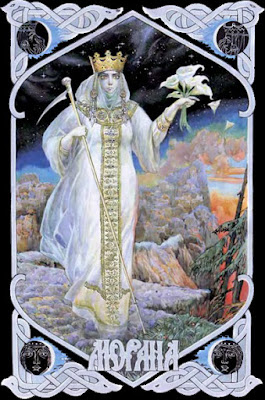
Snow, gale, hail and all of winter things come from Morana, the goddess of death of human, animal and plant life. Her three main attributes are winter death and darkness.


A widespread ritual of burning Morana existed. At the end of winter many of the Slav tribes made a rag and straw doll that symbolized Morana and burned her to help Vesna, the spring, to come faster.

The DARK GOD - The God of Night, Chaos and Evil

Crnobog, as his very name shows, is Slavic black god – god of night, chaos and evil. Slavs believed that all evil originated from this god, so Crnobog, above all other gods, was the least favorably disposed towards men. Most information about Crnobog we gather from Helmold. In one of his records he claims: “There is one curious custom among the Slavs. At their feasts they all drink from the same cup, and while doing that they utter certain words which, I daresay, do not have the purpose of a prayer, but rather a curse in the name of their gods - gods of good and evil. They believe that all good comes from the good god, and all evil from the evil one. And so they call that god Crnobog in their own language.” As we can see, our forefathers thought that the role of one of their gods was to bring misfortune, and from the example above it is clear that they themselves used that god to help them bring about bad luck (the cursing ritual). Misfortune could befall the Slavs in many different ways – through extreme cold, famine, poverty, illness, or simply through a combination of circumstances, and Crnobog was responsible for everything. Building around the fact that cold and darkness made their lives disagreeable, the Slavs postulated an entity that was related to these natural phenomena. Crnobog, Cernobog, or Cert thus became a winter deity and a god of darkness, a terrifying creature that shrouded the world in black. However, we should bear in mind that the Slavs considered Crnobog’s impact was necessary and that consequently Cernobog was respected as all the other gods. None of the sources relevant to Slavic mythology classifies Cert as a lower-rank deity and, regardless of being attributed the source of all misfortune, he was considered equal to other gods of the pantheon. All this means that our forefathers thought accidents were also caused by their gods, or that even extreme cold, famine, death and disease were of divine origin (coming from either Cert or Morana). And what was sent by the gods certainly had to be respected. This illustrates how pagan perception of the world is different to Christian, because Christianity puts earthly life in the so-called vale of tears, while to pagans life, happy and unhappy alike, is a divine bestowal.

            Although old Slavic religion had no dualism characteristics, researchers of Slavic mythology put in opposition to Crnobog a deity of contrasting properties – Belobog. Belobog, as a principle of light and goodness, should have been a contrast to Crnobog, or the power that counterbalances his negative impact. To prove their theory that there was dualism in Slavic mythology the researches claimed that names of some places can be related to Belobog. Some of these places are Belbuch in Pomerania, Belobozice in Bohemia, as well as Bialoboze and Bialoboznica in Poland. However, as Louis Léger claims, the name Belobog cannot be found in any authentic written document concerning Slavic culture. Some Slavic myths, such as the myth of creation, feature Belobog, but we cannot be certain that this myth has its origins in the pre-Christian period. This myth tells that the world was created by Crnobog and Belobog who, through joint effort, brought their creation to perfection. Although during the process of world creation the gods came into conflict, precisely those actions they performed against each other caused the universe to look as it does. There was another dualistic concept that proclaimed Cernobog god of the dark half of the year, opposed by Belobog – the ruler of the sunny half. The rule of Belobog, according to this belief, started with the winter solstice, while Cert’s rule over nature started with the summer solstice. The winter solstice itself was the battle day of these two opposed powers, and on that day Belobog won a victory. This belief could have its roots in authentic Slavic faith since all the other pagan tribes understood that day in a similar way.

            We have already mentioned that records on old Slavic religion give no information whatsoever on family relations between gods. However, Vladimir Aleksejevic Istarhov, the author of The Strike of the Russian Gods, says that Crnobog had a life companion, a she-goat Sedunja, with whom he had a son named Vij. Although Istarhov did not record the myth about this relation, we can conclude that this legend too dates from the period after conversion to Christianity, because Christianity associated horned animals, especially goats, with evil forces.

            However we choose to understand Cernobog, we should remember that no pagan system, including the Slavic one, involves dualism. Polytheism, as a fundamental characteristic of pagan religions, could never contain teachings about one unique primordial cause, or two of them. Due to this fact, the Wicce system for example is a typical product of the new age, because this religion operates on two basic principles – male and female, that is God and Goddess. Slavic neo-paganism also postulates only one god (sometimes it is Rod, sometimes Dazbog) that represents the primeval principle of the universe. Such an idea of the universe did not exist in the authentic Slavic creed, neither did the division between a good and a bad deity. This split could only come through the influence of Christianity, which is based on dualism of good and evil embodied, on the highest level, in God and Satan, and in angels and demons on lower levels.