WoodCrafts & Slavic Gods and Art & SharPei Breed Manual

WoodCrafts & Slavic Gods and Art & SharPei Breed Manual
Welcome to my blog! Here you shall find informations about Ancient Gods of Slavs and Slavic heritage . My pendants and tea mugs collection with authentic design . Shar Pei breed info and manual , WoodCraft ideas. patterns and plans . Stay tuned!
Showing posts with label Slavs. Show all posts

Thursday, October 8, 2015

SVETOVID - God of the visible world and festivities in his honor

Slovenian god of the visible world

The worship of Svetovid or Svantevid has been established among the Baltic Slavs, Rugians and Pomeranians, and the Carantanians in the Alpine region. We encounter him in Middle Europe, and nowhere else.
He was worshipped as Svantevid by the Baltic Slavs - the Rugians and Pomeranians, from the region that was christianized only in the 12th century. He was their highest god, the lord of the visible world. In Slovenian the word means all-seeing one, the root word vid meaning sight.
 His temples among the Rugians were preserved long enough to be recorded by the chroniclers, who report on deities of Pomeranians, or Pomaranian Rugians. The chronicler Hemold (c. *1120 - + 1170) mentions Svetovid in his Chronica Slavorum (I, 52) as Zuantevith, and says about him: "Among many deities of ancient Slavs, Svetovit stands out. He is god of the land of Rugians, effective in fulfilling requests, while other deities are seen as no more than demigods."

The chronicler Saxo Grammaticus, also describes him as the highest god of Rugians. He was god of good harvest, especially the grain harvest. With a good harvest he ensured prosperity for the people. This was represented by the horn of  plenty held in his left hand. His sword indicates, that he was also the god of justice, indicating punishment and protection. The bow held in his right hand indicates that he is also the god of love. The bow does signify war, but is a sign of the god of love when placed in hand of deities, just like the arrow in the hands of Apollo, Artemis and several other deities.
He was a four faced deity, the defender from the forces of evil. One view has it, that four faces represent four seasons. This claim is however contradictory since the god is connected with the summer harvest.
There is less evidence of his worship by Carantanians, the Slavs of the Alpine region. and what there is, is indirect, since the Christianization process began much earlier in this region,  but the pointers are compelling.
There are general indications that among Carantanians pagan gods were adapted and absorbed into the christian system of beliefs, and so remained close to the way the local people experienced life and nature that gave them sustenance.
There are signs that worship of Svetovid, the all-seeing god and god of harvest, was preserved among Carantanians in the figure of  St. Vid or Št. Vid / St. Vitus, an exceptionally popular saint in Slovenian lands. There is first of all the evidence of the name. It would be reasonable to assume that the old pagan Svetovid merged with the saint Vid. This is supported by the popularity of the saint in Slovenian territories. Many churches are dedicated to him, and many place names as well. In addition,  the prevailing opinion among Slovenian ethnologists is that churches tended to be built in places where pagan temples had stood.
Further evidence is provided by the festivities around the time of the saint’s name day, particularly festivities connected to celebration of harvest. There are also links to Svetovid worship in many surviving customs and traditions.The folk tradition of healing, particularly of sight, was connected to the saint and points to the strength of this worship. 

It is a characteristic of Slovenes and Croatians that they pray to Sveti Vid  in cases of eye disease. The explanation might lie in the meaning of the word – “vid”, which means sight in Slovenian. Thus the word vid and the name of the saint - Vid are identical. Further, the word vid is also part of the name Svetovid. So it is reasonable to suppose that prayers for good sight were also directed to the pagan predecessor of St. Vid. In some places, particularly Bela Krajina in south-eastern Slovenia, the custom was to gather dew before sunrise. It was collected with a piece of cloth, the moisture was then squeezed out and used as eye medicine. 

Niko Kuret, eminent Slovenian ethnologist believes that christian missionaries had successfully replaced the old Svetovid with the Christian Saint Vid. According to the old Julian calendar they celebrated his name day on the day of summer solstice, the 24th June, when the bonfires are lit. From 1582 onwards, in accordance to the new Gregorian calendar, it is celebrated a few days earlier, on the 15th June. Just how remarkable must have been the so-called Vidovo or St. Vid Day festival testify, says the ethnologist, the remnants of old customs, still maintaining their hold on the great feast days.

Tuesday, September 29, 2015

SVAROG -Grandfather of the Gods, Creator


We praise Svarog, Grandfather of Gods who is to whole Gods' kin forefather and Creator of everything living, eternal spring that flows in the summer and everywhere and in winter and never it freezes...
( From the Book of Veles Plank 11/a)

Svarog is the God Creator.
Great god of blacksmithing, law and fire.

The origin of Svarog’s name can be traced to the language of Indo-European people, that is to say Sanskrit. Although an exact link has yet to established, some theories suggest the name comes from the Sanskrit word ‘Svarga’ meaning the sky or heaven. Another theory suggests Svarog’s name came from the Indo-Aryan word ‘svar’ meaning the sun, although this theory is discounted by some as the Slavs had possessed a different word for the sun at the time.

As of this writing, the details of Svarog are few. There is some
Svarog had fathered Dazhbog as well as several other gods, these being Perun, Svarozivic, Stribog, Semargl, and Radogost. It is generally believed that Dazhbog and Svarozivic are the same god, as the book of Kolyada mentions Dazhbog’s birth during the striking of the Alatyr-stone, but Svarozivic, who has been attributed to nearly the same aspects as Dazhbog was not mentioned.

The birth of Svarog’s sons is described in the Book of Kolyada’s myth of the creation of the mortal world, one of several myths involving Svarog. The myth states that a great rock, the Alatyr-stone, was brought from the depths of the ocean by a great duck. The rock possessed great magical powers and for this the duck had wanted to hide the stone in it’s beak. Upon finding the duck, Svarog uttered a phrase which caused the stone to grow in size and eventually become too large for the bird to carry.

Soon the stone had become a great mountain and later a center of knowledge of the tales of the gods (vedas) and a mediator between god and man. But upon seeing this, Svarog had decided that no man must know of the stone. With this, he struck the stone with his hammer, but he was only successful in creating sparks. With these sparks, the ratichi (celestial warriors, that is to say gods) were born, this included Semargl, the great god of fire. Because of this, the mighty winds rose, thus creating Stribog, the god of the wind.

After this, the duck who had previously carried the stone conceived a great black snake. The snake, sent to end the stone, crept up to it and struck it to the ground. the stone fell from the heavens and eventually came to be in the land of the mortals (The exact spot was said to be Mount Elbrus in the Caucasus mountains).

The impact of the drop had sent black sparks across the world, with this the dark forces of the world were born. Now Semargl had begun to fight with the snake and it’s troops, but he was outmatched and soon the sun had been blotted out by the snake and the world had been overrun by it’s minions. Defeated, Semargl ascended to the heavenly smithy, followed closely by the great snake. Seeing this, Svarog grabbed the snake’s tongue and tamed it so that it may plow the fields of the earth, whilst sending it’s minions to the underworld.

following this great victory, a half-horse by the name of Kitovras (Known to the Greeks as Chiron) constructed a temple around the stone with the most sacred area in the temple, an altar, being the place where Svarog spoke with man. The myth mentions it was here where Svarog taught man how to make food with milk and cheese curds, which is why the Slavs considered such a meal was a gift from the gods. Since then, this stone has been sometimes attributed to Svarog and in this way he is seen as the creator of the mortal world.

Meanwhile, Svarog had also created the blue Svarga, a land in the heavens where it was said the acnestors of the Slavs would live after death (which is contradictory considering the fact another myth states the souls of the dead would go to the land of Nav, an underworld of sorts. It is a possibility that these two concepts were influenced by separate mythologies, that is to say the Norse and Greek ones, respectively. It is not unlikely, as this conflict of mythologies had been seen before in other parts of Slavic mythology). It was believed the stars of the night sky were the eyes of the grandfathers, who look down from the Blue Svarga upon the Slavic people’s earthly affairs.

Svarog, unlike Veles, does not create the material world with words or magic, but rather his hands. He cared about the Slavs, giving them fire for the cold and to cook food as well as the Sun-Ra (sun) which later became the word for joy (Radost). He also came to the earth to plow the fields and gave the Slavs several gifts. The first, an axe of which to defend their native lands from enemies and the second being a bowl to prepare sacred drinks and the third being tongs of which to create forged weaponry. Finally, his last and possibly most important contribution was the creation of the two circles of time, one of the ground and one of space.

Most commonly, Svarog was thought to be part of the trinity of creator gods, Triglav, among Dazhbog and Perun. Although besides this, the way in which Svarog was honored by the Slavs is not known, nor are any other details on his appearance or personality.

As Christianity began to take hold in Eastern Europe, the idea of Svarog was replaced by Saint Damian, Saint Cosmas and Michael the Archangel. Although paganism was being replaced by Christianity, many were reluctant to give up their old traditions which is why so many attributes of the pagan gods were given to Biblical characters or saints.

PERUN - God of Thunder


Perun is the Slavic god of thunder and the sky. He should not be confused with Svarog, who is also a god of the sky because Svarog is the god of the universe, and Perun belongs to the lower sky, which could be interpreted as the atmosphere. 

He is one of the most powerful Slavic gods. He represents the destroyer because he is the god of bad weather and natural disasters. Perun is a member of the biggest and the most powerful Slavic trinity (Triglav) together with Svarog and Svetovid . In many places, Perun is mentioned as Svarog's and Veles's brother.

Perun also represents the punisher of perjury, as well as the punisher of evil in general. Perun punishes the evil and disobedient by closing the heavenly door to them. He punishes for perjury during the life of the perjurer and uses lightnings in the process of punishing. In many written documents from the early Middle Ages (Nestor's Chronicle, Sbornik Paisijev (Paisije's Anthology), Sofyskij Sobor), and even in peace contracts can be seen that the Slavs swore to obey Perun himself and he was supposed to punish and curse any man who would break the contract. Perun was most often mentioned and frequently satanised in the Christian notes from the early middle ages. This shows us that the cult of Perun was deeply implanted in the Slavs. Their dedication to Perun can also be seen in the fact that many geographical places and plants bear his name (Perun's peak, and Perun's coast in Russia, Perunja ves in Slovenia, mountain Perin in Bulgaria, perunika is iris germanica, etc.). Even today there are sayings and curses with Perun's name in some Slavic languages. 'Go to hell' is 'do Paroma' in Slovakian, where Parom represents Perun. The word 'thunder' is 'piorun' in Polish. The Baltic Slavs called 'Thursday' – 'perendan'.

The name Perun is made from the suffix -un, or -unj (-унь) which signifies the doer of an action, and the root 'per' which means to hit, to break, to smash. Thus Perun indicates a hitter, a breaker, a smasher, a thunderer, and also a deity – the destroyer, the demolisher. This was the reason why natural disasters were attributed to him.

Legends tell us that thunders are heard because of the clattering of the wheels while Perun is riding in his coach in the sky. On statues, Perun was portreyed as a strong man with a beard. Parts of his clothes tell us that he is a warrior in his armour. There are some notions of Perun with a stone sledgehammer in his hand, which he throws at people and petrifies them. There are also notions of him with a bow, which used to be identified with a rainbow, and when he used it, the arrows would turn into lightnings.

Perun was also associated with fire and fiery animals. Perun's animal was a fiery rooster, which is a sort of Slavic Fenix. His beings were also dragons. Rites related to fire were connected with Perun. Next to the idol the eternal fire was burning, which should not be extinguished in any case because, otherwise, all the servants in the temple would be hurt. Perun was also a fighter against droughts. According to one theory, he had an influence on the rain.

As far as plants are concerned, the Perun's plant was an Oak tree. Even today, the Serbs call a kind of an oak tree 'grm', which originates in the word 'grmeti', which means 'to thunder'. It is thus obvious that grm was dedicated to thunder, i.e. Perun. Of the other plants there are iris, sage, nettle, apple, and houseleek. The animals which symbolised him are a he-chamois, and a European bison. When they did not have temples, the Slavs prayed to Perun in groves, at sacrificial altars, and under oak trees.

After the arrival of Christianity, the role of Perun was taken over by St. Elijah. Perun, as well as the stories about him remained in the folk tradition, but some of them took the form of St Elijah stories, and the others had to change the name of the main character. The Church satanised Perun, probably because of his strong cult and strong influence on people's lives.


THE WHITE GOD - The God of Daylight and Everything Good

Belobog is a deity whose historical existence was, and still is, a subject of numerous debates. Belobog, which, translated into English, means White god, is imagined as a counterpart to Crnobog, or Černobog (Black god) and as such represents the light deity of good essentially opposed to the deity of evil.
According to the theory of Peter Kotka, the Slavs accepted Belobog in the period when they lived in the Persian neighborhood (8th – 2nd c. BC). As we know, the Persian religion was dualist in its nature, thus two opposed forces – Ormuzd and Ahriman ruled the Persian universe. The Slavic Belobog would thus correspond Ormuzd, though he was never on such a high place with the Slavs. Furthermore, Kotka presented a Slavic myth in which two opposed forces, just like those mentioned above, were responsible for the creation of the Slavic world, and the forces, of course, were Belobog and Crnobog. Both of these forces were necessary for the creation of the universe, which is, indeed, a principle that could have been taken from the Persians. However, this myth should not be taken for granted since there is a quite different myth about the creation of the universe, and the myth is about a god Rod who created the cosmos from a huge egg.

             However you look at it, the impression that Belobog is more of an abstract principle than a typical anthropomorphic deity stays, which can be seen in the way it was represented by the Slavs. Well, how was this deity represented? The Slavs imagined Belobog as an old man with a long white beard, dressed exclusively in white. As such, he would appear only during the daylight, doing good deeds as he went and bringing people success and happiness. Belobog helped many peasants to finish hard work in the field and he showed many strayed travelers the way out of a thick forest. The general impression of whiteness, light and positively made him an abstract deity, completely different from other gods. This is why he is more likely the very principle of light and goodness wrapped in the form of an anthropomorphic deity, than a god pagans would otherwise bow to.

Whether it is an abstract principle, or a manifestation of the supreme god (Ormuzd or Christian Yahweh), the appearance of Belobog in the Slavic mythology should by no means be ignored. Certain data about the notion of him with the Slavs can be found through the analysis of the name of this deity. Belobog's name reminds us a lot of the names of gods of other pantheons: Baldur, Belunos, Baal etc. All these deities are also of a light and solar nature since their names contain the same root (bal means something light and bright). The very occurrence of Baldur in the Nordic mythology is parallel to the occurrence of Belobog in the Slavic – both seem a bit of a foreign body in their systems, by being different in every possible way from other gods and by making their appearance seem extremely mysterious.  The same rules were applied both to Baldur and Belobog, Baldur was considered to be a Christian creation, wherefore he was even named Hvit Christ, i.e. White Christ. As far as the Serbs are concerned, Belobog's name has, up to now, remained with the people who use it to denote a deity, which can be seen in an old saying “he ate the white god”, used to show that somebody ate very much, i.e. that he ate everything there was to be eaten.

Monday, September 28, 2015

How the Slavs worship trees

Worshiping trees is common for many ethnic groups and religions, and Slavs are no exception, since Slavs lived in an area covered with dense forests.
 The cult of sacred trees was widely spread and strong among Slavs. The statue of Gods and temples were made from wood. It was believed that trees have magic power, probably because of its longevity and ability of regeneration. 

The tree is considered as symbol of the universe as well as youth, wisdom, life, fertility, immortality. It was believed that trees are dwelling places for souls.
Slavic tribes had strong connection with nature and they believed in many gods that were patrons of forest, meadows, flowers, earth, sun… They also believed that every plant has a soul. Different sort of trees were subject of worshiping and sometimes forest was used instead of temples.

In front of the tree various rituals and celebrations were performed. Those trees had status of sacred ones and no one was allowed to cut or took any part of them, afraid of revenge of the spirits who lived inside the tree. If anyone broke this rule it was believed that he or some of his family members will die or have an accident. Almost every village had its sacred tree. The rituals that were performed consisted of prayer, adorning tree with flowers, red strings and fruits. The sacred tree was patron of the village and protected its inhabitants from the thunder, drought and flood. Under the tree people organized meetings where important decisions were made. One of the most sacred trees among Slavs was oak tree. It was considered as tree that belongs to God Perun, the main deity of Slavic pantheon. Besides oak, other sorts of trees were worshiped: pear, yew, hornbeam and linden. 

Dendrolatry in Slavic religion

Worshiping of oak tree continued its existence until nowadays in Christmas tradition. Although Slavic tribes are baptized, they could not completely forget their pagan Gods, so they incorporated old religion with Christianity. On the Christmas Eve branches of the oak tree are ritually burned. They represent deity, the God of vegetation that is burned in order to be born again. This is a symbolical presentation of life cycle.

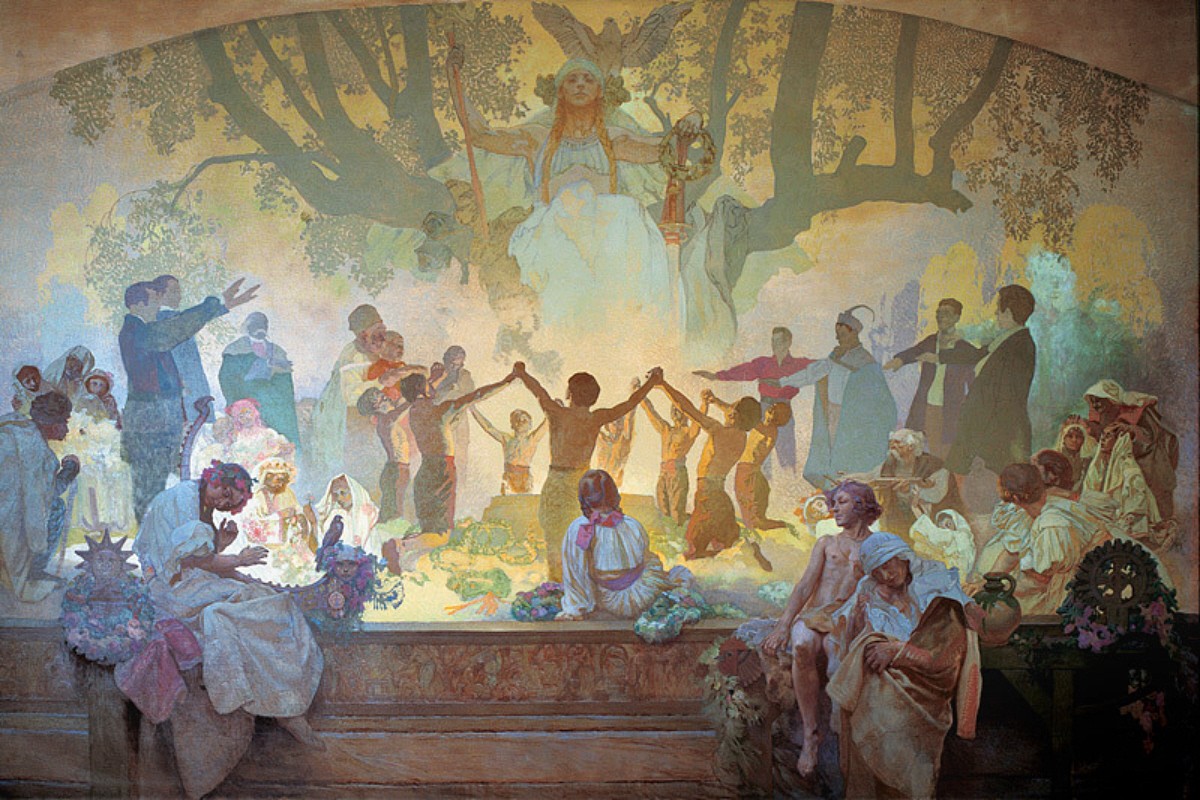
The Slav Epic trees

Sometimes instead of oak other sorts can be used like yew tree or beech. Before tree is burned it is treated like deity. The bread and wine are offered as sacrifice. These rituals have a goal to transfer the magic power of the tree to the people. During the burning of the tree people would wish happiness, wealth, health and fertility. It was believed that some trees can captivate the souls of the dead and be their dwelling place. Apple tree sometimes was planted on the graves because of its ability to keep the souls. Since in traditional beliefs trees had divine nature, it was thought that they can protect from illness and misfortunes. 

The pieces of hawthorn wood were used as amulet since it was the most powerful in protecting from demons. On the other hand it was believed that in some trees lived demons, witches and other evil creatures. Nut tree belonged to the underworld and demons, and it was never planted near houses. Linden forests were also cult places among Slavs.

The statues of gods were made from the linden wood, under the tree – weddings were celebrated. Yew tree is, according to legends, “fairy tree” and protects from demons, curses, witches and other evil forces. The pieces of yew tree were used as amulet for protection of people and cattle. Maple tree was also sacred tree associated with cult of the dead and ancestor cult. In the past, people were buried in hollow maple timber in order that tree protects soul from demons in the afterlife. Although Slavic people started being baptized centuries ago, the cult of tree survived until nowadays and is incorporated in Christian tradition.